East Tennessee History · County by county
A county that was founded three times, a valley named for an iron forge and the pigeons that filled its skies, a mountain village that became the front door to America’s most visited national park, and a hometown girl who came back to build a theme park.
Sevier County runs from the farm bottoms along the French Broad River up through the foothills to the crest of the Great Smoky Mountains, including Kuwohi, the highest point in Tennessee. [S34][S110] It has an unusual claim: it was organized three separate times, under the State of Franklin in 1785, the federal Southwest Territory in 1794, and the new State of Tennessee in 1796. [S34] For most of its first 150 years it was a quiet farming county. [S84] Then the national park, a new highway and a few big ideas turned Sevierville, Pigeon Forge and Gatlinburg into one of the busiest vacation regions in the country. [S34][S84][S20] About thirty percent of the park lies inside Sevier County. [S84] Today the county has four incorporated cities: Sevierville, Pigeon Forge, Gatlinburg and Pittman Center. Places such as Seymour, Kodak, Wears Valley and Fairgarden are unincorporated communities. [S117]
People lived along these rivers for thousands of years before any European arrived. [S84] Near Sevierville, the McMahan Mound is a flat-topped earthen platform about sixteen feet high, built by Mississippian farmers during what archaeologists call the Dallas phase, roughly 1200 to 1500. It was first dug in 1881, and its artifacts went to the Smithsonian. Later digs nearby found village sites going back to the Woodland period. [S112] (See the region’s mound-building story in chapter 1 of our East Tennessee history.)
Spanish expeditions under Hernando de Soto in 1540 and Juan Pardo in 1567 crossed this country, which then belonged to a chiefdom called Chiaha, centered on a river island near today’s Douglas Dam. [S84][S106] By the late 1600s the Cherokee were the main nation in the region and used the Sevier County valleys largely as hunting grounds. [S84] Two branches of the Great Indian War Path crossed the county, and in the 1780s those same trails became the main roads for settlers moving in. [S34]
The fighting that opened Sevier County came during the Revolution. On December 16, 1780, while many frontier militiamen were still returning from the Kings Mountain campaign, John Sevier led a force that defeated a large Cherokee war party at Boyds Creek. A granite shaft put up in 1927 marks the site today. [S90][S85]
After the war, settlers in what is now upper East Tennessee formed the breakaway State of Franklin and elected Sevier governor. [S6][S85] In March 1785 Franklin held the first Sevier County court at Samuel Newell’s Station on Boyds Creek. [S34] That June, on June 10, 1785, Franklin’s commissioners, Sevier among them, met Cherokee leaders including Ancoo of Chota at Maj. Hugh Henry’s Station near today’s Kodak and signed the Treaty of Dumplin Creek. [S91][S115] It was the only treaty Franklin ever made, and it opened land south of the French Broad and Holston rivers that later became parts of Blount, Hamblen, Jefferson, Knox and Sevier counties. [S115][S92] North Carolina never recognized Franklin, and the state faded away by 1788–89. [S6][S85]
The county’s second birth came under the federal territory. Sevier County was created from part of Jefferson County on September 18, 1794, and it has kept the same boundaries ever since. [S84] Its first territorial court met at the home of Isaac Thomas on November 8, 1794. [S34] In January 1796 five Sevier County men went to Knoxville to help write Tennessee’s first constitution, and the county began its third life as part of the sixteenth state. [S34][S85] County and seat are both named for John Sevier, Tennessee’s first governor. [S34][S84]
Sevierville began about 1783 as a settlement called the Forks of Little Pigeon, where the east and west prongs of the Little Pigeon River meet. [S93] Isaac Thomas, an Indian trader, had a home there that served as courthouse, fort and tavern, and James McMahan set aside a 25-acre tract for a town. It became the county seat in 1795. [S93][S34] The Forks of Little Pigeon Baptist church, founded in 1789, is said to be the first church of any kind in the county; its old cemetery still sits near downtown. [S94] The county government calls Sevierville the eighth-oldest city in Tennessee, though it did not keep a lasting city charter until 1901. [S84][S34]
Schooling came early too. Nancy Academy, named for Nancy Rogers, said to be the first white child born south of the French Broad, opened in the early 1800s and taught local children for most of the century. [S34] (A state marker and the encyclopedia give different opening and closing years.)
Fire shaped the town’s records. On March 31, 1856, a fire accidentally started by the sheriff burned the courthouse, the jail, dozens of houses and most of the town’s businesses, along with many county records. A young inmate died in the blaze. [S95] Pieces of the old jail bars were later turned into storm-drain grates; one still sits on the street with a marker beside it. [S95]
Sevier County was strongly Unionist. In the statewide vote of June 8, 1861, its voters rejected secession 1,528 to 60, even though Tennessee as a whole voted to leave the Union. [S84] That November, as part of the East Tennessee bridge-burning plot, Sevier County sheriff William C. Pickens led a failed attempt to burn the railroad bridge at Strawberry Plains. [S84][S15] (Read the regional story in chapter 6 of our East Tennessee history.)
The war came to the county itself in the winter of 1864, when Confederate Gen. James Longstreet’s army was foraging across East Tennessee. On January 27, 1864, Union cavalry attacked Confederate horsemen in heavy fog east of Sevierville in what is called the Battle of Fair Garden. A late-afternoon saber charge scattered the Confederates, though the Federals soon had to pull back and give up the area. One of the Union batteries was led by Capt. Eli Lilly, who later founded the drug company that bears his name. [S96]
Pigeon Forge started in the 1780s as a farm community called Fanshiers, settled by the Wear, Fancher and Lovelady families. [S34] The town’s name comes from two things. The first is the passenger pigeons that once flocked to the valley by the thousands, the birds that also gave the Little Pigeon River its name. [S97] The second is an iron forge that Isaac Love set up beside the river. The encyclopedia dates it to 1817; the National Register nomination says ironmaking there began by about 1820. [S34][S97] Love mined ore from nearby hillsides and worked it in a bloomery forge, but the ore was never good enough to make the business pay, and full-time ironmaking ended in the late 1830s. [S97] Another ironworks, Sweden Furnace, ran northwest of Sevierville in the same years. [S34]
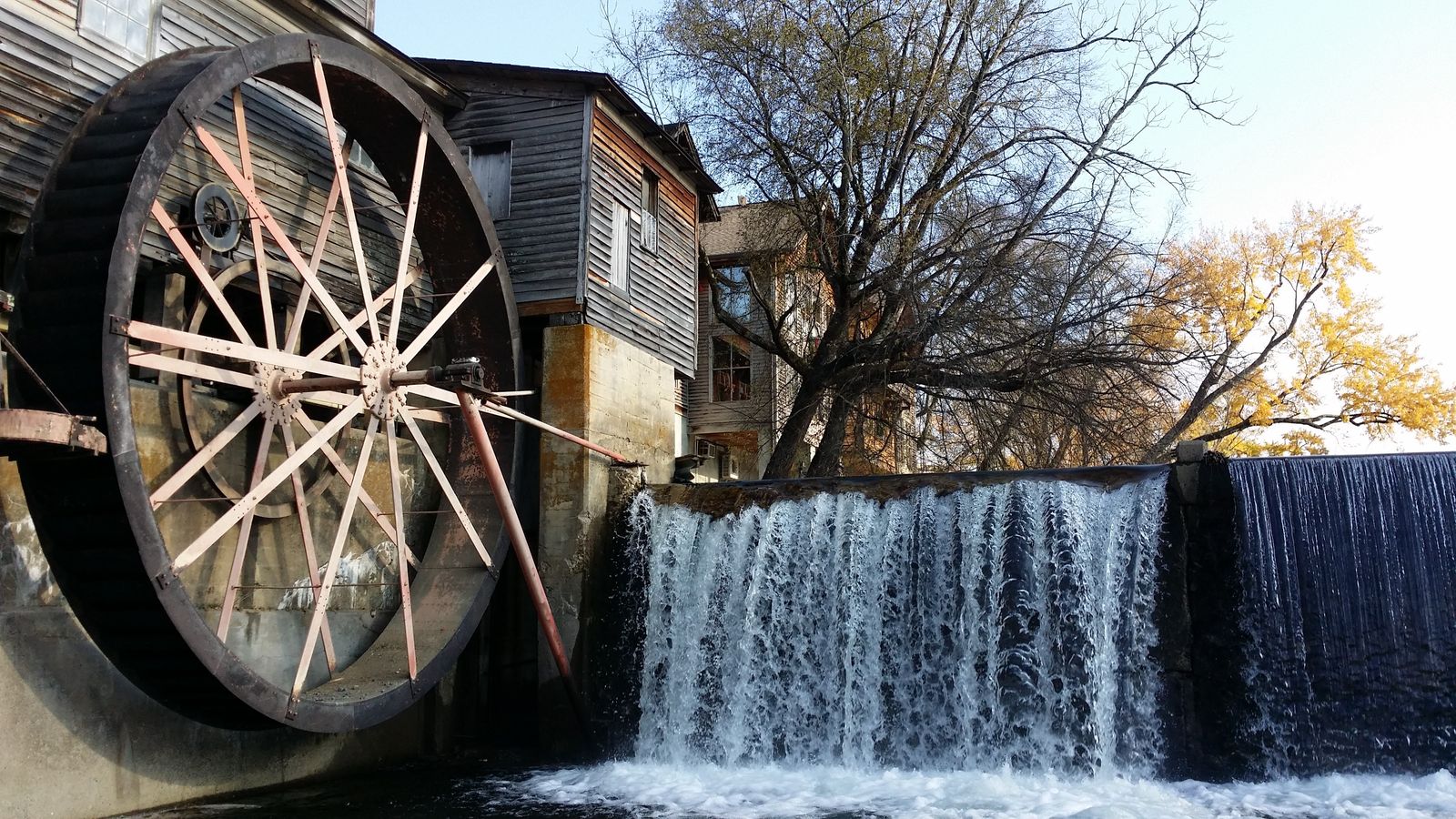
In 1830 Love built a big water-powered mill next to the forge. [S97] Over the next century it ground local wheat and corn, ran looms that made cloth during the Civil War, sawed lumber, and in the early 1900s powered a generator that supplied the neighborhood with electricity until 1930. [S97] The Pigeon Forge post office opened in 1841 with Isaac’s son William K. Love as postmaster. [S34] The Old Mill still turns on the Little Pigeon and was placed on the National Register of Historic Places in 1975. [S97] Pigeon Forge itself did not incorporate until 1961. [S34]
Some of Sevierville’s finest buildings are the work of Black craftsmen. Isaac Dockery, a brickmaker and mason born in Sevier County, fired bricks in his own kilns and built or supplied many of the town’s landmarks after the Civil War, and he trained generations of local masons. [S98][S34] In 1886 Dockery and other Black families of Sevierville built New Salem Baptist Church. It is the oldest surviving building in Sevierville and the county’s oldest brick church, and it joined the National Register in 2003. [S99] Lewis C. Buckner, born enslaved, became a carpenter and cabinetmaker whose carved furniture, mantels, staircases and porch trim decorate Victorian houses across the county. [S100][S34]
The courthouse that stands today was finished in 1896, the year of Tennessee’s centennial. [S34][S101] Designed by Louisville architects in the Beaux Arts style, it rises on a locally quarried limestone foundation to a clock tower that can be seen for miles, and Dockery’s bricks went into its walls. [S101][S98][S114] It is listed on the National Register of Historic Places. [S114] Most of the brick storefronts facing it on Court Avenue were built in the early 1900s, many by Black artisans. [S101]
The 1890s were also a violent decade. A vigilante group called the White Caps began whipping and threatening people, mostly women, whom its members judged immoral, and juries were often rigged to free them. In 1894 a citizen posse called the Blue Bills formed to fight back, and a gunfight that November left three men dead. Public opinion finally turned after the White Caps murdered a young couple, William and Laura Whaley, in December 1896. Two men were convicted and hanged at the courthouse in 1899, and a new sheriff, elected in 1898, persuaded the legislature to pass laws aimed at the vigilantes. [S102]
For decades the county’s trade moved by water. From the 1870s into the 1920s, flatboats carried goods from Sevierville down to steamboats on the French Broad. [S34] Then came the railroad. In a December 1907 special election, voters approved a county investment in a new line, 2,008 to 555. [S104] The Knoxville, Sevierville & Eastern Railway, built by Knoxville industrialist W. J. Oliver, ran about 28 miles from south Knoxville through the Boyds Creek valley. Its first train reached Sevierville on January 9, 1910, to a crowd of more than six hundred. [S103][S104] Riders nicknamed it the "Knoxville, Slow & Easy." [S103][S104] One station was renamed Seymour for the railroad’s chief engineer, Charles Seymour. [S104] Today Seymour is a community that reaches into both Sevier and Blount counties. [S117] An extension called the Pigeon River Railroad got as far as McCookville, south of Pigeon Forge, by 1920, but never reached Gatlinburg. [S34][S104]
The line rarely made money. It had one good stretch during World War II, when it hauled most of the equipment and materials for TVA’s Douglas Dam. [S103][S104] Passenger service ended in 1950, and the last trains ran in January 1961. [S104][S34] Its steam locomotive No. 107 was sold that year to a new Pigeon Forge attraction called Rebel Railroad, the park that would one day become Dollywood. [S104][S30]
Up in the mountains, the big business was timber. Logging boomed in the Smokies from about 1900 to 1930. [S34] In 1908 the Little River Lumber Company built a company town at Elkmont, on the Sevier County side of the mountains. By 1918 it had more than 1,500 residents and was the county’s second-largest town, with a store, school, church, hotel and a railroad hauling logs down to the sawmill at Townsend in Blount County. [S105][S106] The company leased land nearby to two Knoxville vacation clubs, the Appalachian Club and the Wonderland Club. In 1925, with the timber cut, the company pulled up its rails and closed the town. [S105] Elkmont’s site is now the largest campground in the national park. [S105]
Gatlinburg began as White Oak Flats, named for the oaks that covered the valley floor. [S107] William Ogle picked out a homesite there around 1802 but died before he could move his family from South Carolina. His widow, Martha Jane Huskey Ogle, brought her children and her brother’s family to the spot around 1806–07, finished the cabin, and stayed. [S107][S34] The Ogle cabin still stands downtown. [S107] Merchant Radford Gatlin opened a store in the 1850s, and when a post office opened in it in 1856, the community took his name. Gatlin, a controversial preacher, was later forced to leave town, but the name stuck. [S107][S34]
There were no public schools in the area when the women of Pi Beta Phi, a national women’s fraternity, went looking for a place to start a service project. They chose Gatlinburg, and local families raised the money to buy land on the condition that the school not be tied to any church. [S86] Classes began in March 1912 in an empty church building. [S86][S107] The Pi Beta Phi Settlement School grew to include farm and home training and a health clinic whose nurse, Phyllis Higinbotham, was the first trained nurse in the county. [S86] Teachers also encouraged local weavers, basketmakers and woodworkers, and from the mid-1920s their work was sold nationally under the Arrowcraft name. [S86][S87] The county took over the public school in 1965. [S86][S87]
Craft became Gatlinburg’s calling card. In 1945 Pi Beta Phi and the University of Tennessee started summer craft workshops on the campus, and in 1948 the Southern Highlands Handicraft Guild held its first craftsman’s fair there. [S87][S86] The program grew into the Arrowmont School of Arts and Crafts, which took that name around 1969–70 and still teaches artists from around the world. [S87] The town’s visitors bureau dates the Great Smoky Arts & Crafts Community, the loop of studios east of town, to 1937. [S107]
Over on the county’s quiet eastern side, on the Pigeon River, the Methodist Church opened Pittman Community Center on August 15, 1921, with money raised largely by Dr. Eli Pittman of New York. The school and clinic, with its model farm and cannery, served one of the most isolated parts of the mountains for more than forty years. [S88][S34] The town of Pittman Center incorporated in 1974. [S34]
The campaign for a national park in the Smokies started with Knoxville boosters in 1923. [S20] Because almost all the land was privately owned, much of it by timber companies, Tennessee and North Carolina had to buy it and give it to the federal government. [S20] Congress authorized the park in 1926, school children and wealthy donors alike pledged money, and John D. Rockefeller Jr. gave $5 million in memory of his mother. [S20] The National Park Service dates the park’s establishment to 1934, and President Franklin D. Roosevelt dedicated it on September 2, 1940. [S106][S20] More than four thousand people had to leave their homes inside the new boundary. [S20] Gatlinburg’s visitors bureau notes that many displaced mountain families moved into town and went to work in its new hotels and shops. [S107]
The park’s highest summit, long called Clingmans Dome after an 1859 survey, was officially given back its Cherokee name, Kuwohi ("mulberry place"), on September 18, 2024, at the request of the Eastern Band of Cherokee Indians. [S110]
Gatlinburg incorporated in 1945, the same year the war ended and tourists came back. [S34][S107] In the 1950s a new U.S. 441 was built through the middle of the county, opening the valley to car travelers. [S34] Ray L. Reagan, the county judge from 1956 until his death in 1978, pushed to bring in industry and helped build the county’s industrial park, medical center and airport. [S34] By the 1990s most of the county’s workers had jobs in trade and finance tied to tourism. [S34]
Dolly Parton was born on January 19, 1946, at Locust Ridge in Sevier County, the fourth of twelve children in a poor farm family. [S89][S116] She was singing on Knoxville radio and television by about age ten and moved to Nashville the day after she finished high school in 1964. [S89][S116]
The theme park that carries her name has a longer history than many visitors realize. In 1961 the Robbins family rebuilt an old logging railroad and opened Rebel Railroad in Pigeon Forge. It became Goldrush Junction in 1970 and, under the Herschend family, Silver Dollar City in 1977. [S30] Parton partnered with the Herschends in 1985, and the enlarged park opened as Dollywood in 1986. [S30][S89] Together with the businesses that grew up around its gates, Dollywood made Pigeon Forge the county’s biggest money-maker. [S30] In 1995 the Dollywood Foundation started Dolly Parton’s Imagination Library in Sevier County, mailing a free book every month to each child under five; its first order was 1,760 books. [S111] (More in chapter 12 of our East Tennessee history.)
In late November 2016, the Chimney Tops 2 Fire started in a remote, steep part of the national park on November 23. [S108] Five days later, on November 28, exceptional drought and winds gusting up to 87 mph drove it out of the park. Embers and downed power lines set new fires across the Gatlinburg area. [S108][S109] Joined with other fires, the blaze became known as the Sevier County fires. Fourteen people died. [S109] Inside the park the fire burned about 11,000 acres, but no park buildings were lost. [S108][S109]
| Year | What happened |
|---|---|
| c. 1200–1500 | Mississippian people build the McMahan Mound near Sevierville [S112] |
| 1540, 1567 | De Soto and Pardo expeditions pass through [S84] |
| 1780 | Battle of Boyds Creek, Dec. 16 [S90] |
| 1785 | First Sevier County court under Franklin (March); Treaty of Dumplin Creek, June 10 [S34][S91] |
| 1789 | Forks of Little Pigeon Baptist Church founded [S94] |
| 1794 | Sevier County created from Jefferson County, Sept. 18 [S84] |
| 1795 | Sevierville becomes county seat [S34][S93] |
| 1796 | Sevier County delegates help write Tennessee’s first constitution [S34] |
| c. 1806–07 | Ogle family settles White Oak Flats (Gatlinburg) [S34][S107] |
| 1817–c. 1820 | Isaac Love’s ironworks at Pigeon Forge [S34][S97] |
| 1830 | Pigeon Forge mill (the Old Mill) built [S97] |
| 1856 | Sevierville fire, March 31; Gatlinburg post office named [S95][S34][S107] |
| 1861 | County votes 1,528 to 60 against secession, June 8 [S84] |
| 1864 | Battle of Fair Garden, Jan. 27 [S96] |
| 1886 | New Salem Baptist Church built [S99] |
| 1896 | Sevier County Courthouse finished [S34][S101] |
| 1908 | Elkmont logging town built [S105][S106] |
| 1910 | First train reaches Sevierville, Jan. 9 [S104] |
| 1912 | Pi Beta Phi Settlement School opens in Gatlinburg [S86] |
| 1921 | Pittman Community Center opens, Aug. 15 [S88] |
| 1925 | Elkmont logging ends [S105] |
| 1940 | Great Smoky Mountains National Park dedicated, Sept. 2 [S20] |
| 1945 | Gatlinburg incorporates; Arrowmont’s summer workshops begin [S34][S87] |
| 1961 | Pigeon Forge incorporates; Rebel Railroad opens; last train on the old KS&E [S34][S30][S104] |
| 1986 | Dollywood opens [S30] |
| 1995 | Imagination Library starts in Sevier County [S111] |
| 2016 | Chimney Tops 2 Fire reaches Gatlinburg, Nov. 28 [S108][S109] |
| 2024 | Clingmans Dome renamed Kuwohi [S110] |
Start in downtown Sevierville at the courthouse and walk Court Avenue and Bruce Street, where markers tell the stories of the railroad, the 1856 fire and the town’s Black builders. Stop by New Salem Baptist Church and the Forks of the River cemetery. Drive the back roads northwest to the Battle of Boyds Creek monument, or east to the 1875 Harrisburg Covered Bridge. [S113] Head south to Pigeon Forge and the Old Mill on the Little Pigeon, then on to Gatlinburg for the Ogle cabin, Arrowmont’s galleries and the Arts & Crafts Community loop. End in the national park at the old Elkmont town site, or at Kuwohi if the road is open. Check hours and road conditions before you go. Next door, Wears Valley leads over to Townsend in our Blount County guide.
Visit: Sevier County Courthouse, Sevierville · Sevier County Heritage Museum, Sevierville · The Old Mill, Pigeon Forge · Arrowmont School of Arts and Crafts, Gatlinburg · Great Smoky Arts & Crafts Community · Elkmont Historic District, Great Smoky Mountains National Park · Harrisburg Covered Bridge
Every bracketed number on this page links here. Written by My East TN in our own words and checked against each source on 2026-10-28 (ET). Where sources disagree (for example, on whether Isaac Love's Pigeon Forge ironworks began in 1817 or about 1820, whether the Ogle family reached White Oak Flats in 1806 or 1807, when Nancy Academy opened and closed, or which year the courthouse joined the National Register), we give the range or leave the exact year out. We don’t republish encyclopedia or museum text — follow the links for the full articles.
Images: My East TN photos and Studio illustrations only. Corrections: [email protected].