East Tennessee History · County by county
A frontier county on the Clinch River that coal miners, the TVA, the Manhattan Project and the Clinton 12 each put on the national map in turn.
Anderson County was carved out of Knox and Grainger counties in 1801 and named for a U.S. senator. For most of the 1800s it was a place of small farms along the Clinch River, with coal in the northern ridges. Then, again and again, the county ended up at the center of a national story. Coal miners at Briceville rose up against convict labor in 1891. The new Tennessee Valley Authority built its first dam and a model town at Norris in the 1930s. The Army raised the secret city of Oak Ridge in the 1940s to help build the atomic bomb. And in 1956 twelve Black students at Clinton High School became the first to integrate a state-supported high school in Tennessee. [S32][S17][S22][S23][S25]
The General Assembly passed the act creating Anderson County on November 6, 1801, and it took effect that December. [S54][S32] The land came from Knox and Grainger counties. [S32][S53] Lawmakers named the county for Joseph Anderson, a U.S. senator who had earlier served as a territorial judge in Knoxville. [S32][S53] Until a courthouse could be built, the county court was to meet at the home of Joseph Denham Sr. [S54]
The same act ordered a county seat laid out on the north side of the Clinch and named it Burrville, after Vice President Aaron Burr. [S54][S32] Burr soon fell from favor. After his duel with Alexander Hamilton left Hamilton dead, Burr was also linked to a shady western land plan. In 1809 the legislature renamed the town Clinton. [S53] The sources aren’t sure which Clinton it honors: DeWitt Clinton or his uncle, Vice President George Clinton. [S32][S53]
Archaeology shows that Native Americans lived on this land long before Tennessee became a state. [S32] The first permanent white settlement came in the mid-1790s, when Thomas Frost built a cabin, and German immigrants followed around 1800. [S32][S53]
Early families farmed mostly to feed themselves, with a few small businesses on the side. Coal changed that. Speculators started buying up coal land in the 1830s, and once railroads reached the county in the middle of the century, coal mining became its leading industry. [S32][S53]
Anderson County also cared about schools early on. Union Academy opened in Clinton in 1806 and began taking girls as well as boys in 1817. By the 1840s Clinton had two more church schools: Clinton Seminary (Baptist) and Clinton Grove Academy (Methodist). After the Civil War, county school superintendent Charles D. McGuffey pushed for public school funding. By 1892 the county ran fifty-eight public schools, five of them for Black students. [S32]
No major battles were fought here. But, like much of East Tennessee, the county split between Union and Confederate loyalties, and neighbors often settled quarrels with violence. "Bushwhacking" was common. [S32] The Confederates set up a conscription center at Clinton. Union men who wanted to slip away to Kentucky and join the Union army hid at a safe house remembered as "Eli’s Cabin." [S32]
By the 1890s, Tennessee was renting out its prisoners to private coal companies. The state called this convict leasing. It cut costs for the companies and undercut the wages of free miners. [S17] On July 14, 1891, about three hundred miners surrounded the convict stockade at Briceville. They marched the forty prisoners and their guards about five miles to Coal Creek, put them on boxcars and shipped them to Knoxville. [S17] Gov. John P. Buchanan sent the militia to put the convicts back to work and told the miners to take their case to court. [S17]
The legislature met in a special session but did little. So on October 31, 1891, the miners struck again. This time they set the Briceville convicts free and burned the stockade. [S17][S18] Two days later they raided a mine at Oliver Springs. [S17] Fighting flared again in August 1892. In the end, the 1893 General Assembly voted to build a new state prison and to end leasing when the contracts ran out in the mid-1890s. [S17] That prison was Brushy Mountain, just over the line in Morgan County. [S17][S32] (Read more in our Morgan County history.)
The coal towns had more sorrow ahead. Mine explosions at Fraterville in 1902 and Cross Mountain in 1911 are among the county’s worst disasters. [S53] Coal Creek itself was renamed Lake City in 1936, after Norris Lake filled, and in 2013 the city council asked the state to rename it Rocky Top. [S53] Meanwhile, in the 1890s, Oliver Springs, where Anderson, Roane and Morgan counties meet, drew rail travelers to its resort hotel and mineral springs. [S32][S53]
Congress created the Tennessee Valley Authority in 1933, and its first big project was in Anderson County. [S21][S32] Work on Norris Dam began in October 1933 on the Clinch River and was finished in March 1936. [S22] It was named for Sen. George Norris of Nebraska, who had fought for years for public power in the valley. [S22] TVA’s first chief architect, Roland Wank, reshaped the plain government design into the clean, modern look that TVA dams kept for decades. Inside, a sign reads "Built for the People of the United States." [S22] The dam brought jobs, flood control and electricity to the county. [S32][S53]
TVA also built the town of Norris in 1933 to house the dam workers. [S47] The planners borrowed from old mountain houses, including the dogtrot, and set homes along the natural slope of the land to save trees. No earlier standalone town in the country had been planned with a protective greenbelt of open land around it. [S47] Its creamery was the world’s first all-electric milk plant. [S47] After World War II, Congress told TVA to sell the town, and on June 15, 1948, it went at public auction to a group of Philadelphia investors. [S47] Norris incorporated in 1949, and today it’s a historic district on the National Register. [S53][S47]
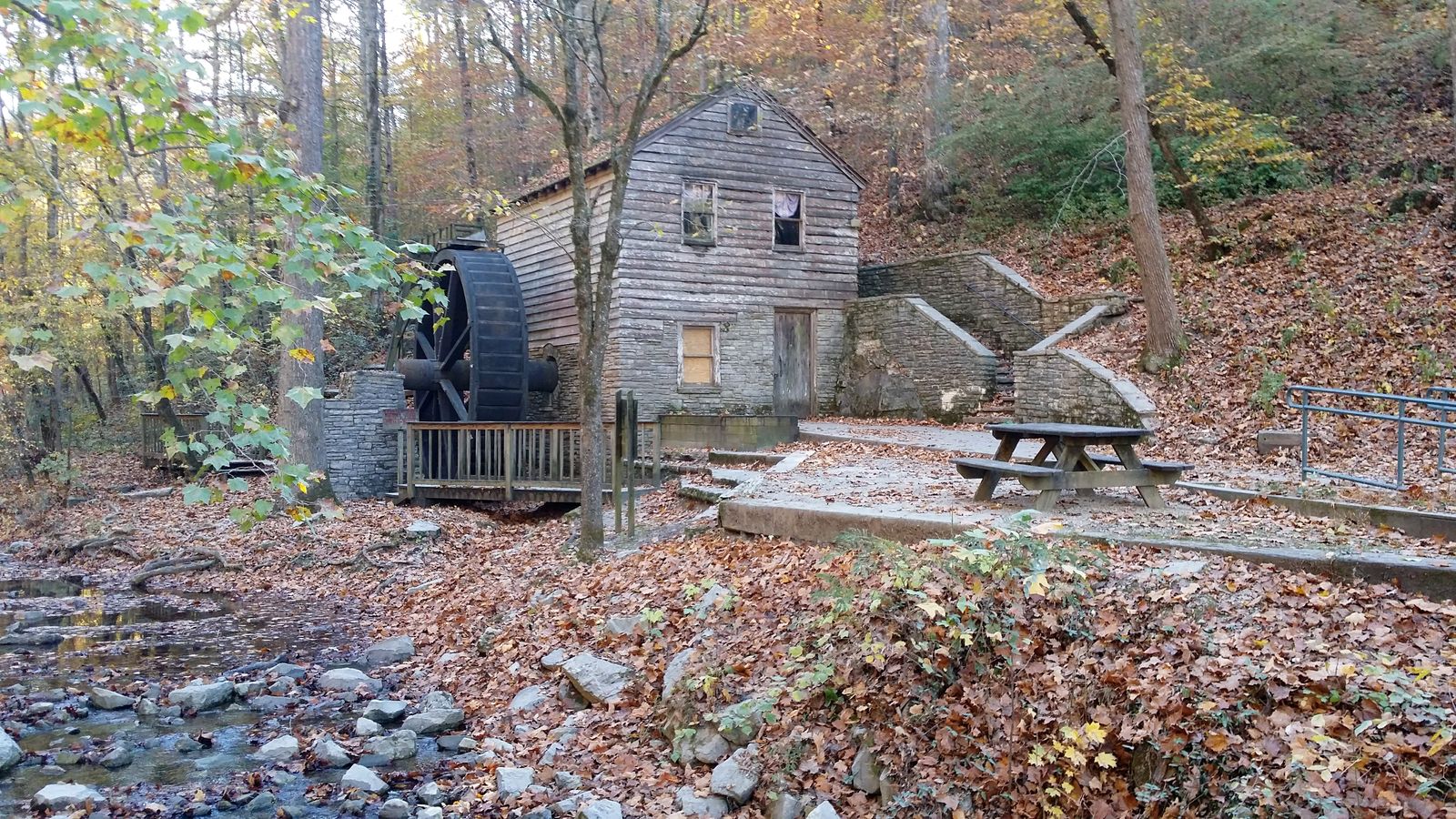
Working with the Park Service and Civilian Conservation Corps crews, TVA built public parks at Norris and at Big Ridge (just across the line in Union County). [S32][S50][S52] At what is now Norris Dam State Park, a CCC company set up camp in 1934. The crews built cabins, trails and a lodge, and they moved and restored a gristmill from around 1798. [S50] The state took over the park in the early 1950s, and it was one of Tennessee’s first five state parks. [S50]
In the fall of 1942, the U.S. Army chose the Clinch River valley as a main site for the Manhattan Project, the secret effort to build an atomic bomb. [S23][S24] The site offered TVA power, plenty of water, a rail line, cheap land, and long valleys between ridges that could keep each plant apart from the others. [S23] About a thousand farm families, roughly four thousand people, lived around crossroads such as Wheat, Elza, Scarboro and Robertsville. Some learned they had to move from notices nailed to their fence posts, and within a year they were gone. [S23] Anderson County gave up about a seventh of its land and Roane County about an eighth. [S23]
The Army called the reservation the Clinton Engineer Works. The Clinch River bent around it on three sides, and a guarded fence closed off the rest. [S23] Inside, three huge plants went up. At X-10, the Graphite Reactor went critical, sustaining a chain reaction on its own, on November 4, 1943, and made some of the world’s first plutonium. [S49] Y-12 and K-25 used two different methods to separate the rare uranium-235 that fueled the bomb dropped on Hiroshima on August 6, 1945. [S23]
The town grew almost overnight. The planners laid out streets by state names in alphabetical order, so every street off Delaware Avenue starts with a D. Then they raced to add trailers, barracks and dorms. [S23] By the summer of 1945, about 75,000 people lived in Oak Ridge, and the two-year-old town was among the largest cities in Tennessee. [S23][S32] Housing was segregated: Black workers were put in hutments, separated by race and by sex. In 1955, though, Oak Ridge became one of the first Southern cities to order its public schools desegregated. [S23] The gates opened to the public in 1949, the same time the American Museum of Atomic Energy opened its doors. That museum is today’s American Museum of Science and Energy. [S23][S51] The X-10 reactor shut down in 1963 and became a National Historic Landmark in 1966. [S49]
After World War II, Black families in Clinton pressed for better schools. Their small Clinton Colored School was renamed for Green McAdoo, a Buffalo Soldier veteran who had worked as the courthouse custodian. [S25] There was still no Black high school in the county. In December 1950, families sued the county school board, and Thurgood Marshall of the NAACP helped argue the case. [S25] After Brown v. Board of Education in 1954, the case came back to federal court. In January 1956, Judge Robert L. Taylor ordered the school board to desegregate by that fall. [S25]
In late August 1956, twelve Black students walked down Foley Hill from the Green McAdoo School to Clinton High School. No state-supported high school in Tennessee had been desegregated before the Clinton 12 walked in. [S25] Within days, segregationist organizer John Kasper arrived in town and stirred up crowds. Over Labor Day weekend, mobs rioted in town. Clinton’s leaders asked Gov. Frank G. Clement for help, and about six hundred National Guardsmen restored order. [S25][S32] On December 4, the Rev. Paul Turner of First Baptist Church and two other white men walked the students back to school. Afterward, a mob beat Turner badly. [S25] CBS newsman Edward R. Murrow brought the story to the nation that winter on See It Now. [S25][S32]
On May 17, 1957, Bobby Cain graduated from Clinton High School. He was the first Black student to graduate from an integrated public high school in the South. [S25][S55] A year later, Gail Ann Epps became the first Black woman to graduate from an integrated public high school in Tennessee. [S25] Then, on October 5, 1958, bombs wrecked much of the school building. Students attended classes in Oak Ridge while Clinton High was rebuilt, with help from Billy Graham and many local people. [S25][S32] Today the Green McAdoo Cultural Center, at the top of Foley Hill, keeps the Clinton 12’s story. [S59]
In 1962, John Rice Irwin went to a farm auction near Norris. He was upset to see bidders turning old tools into decorations, so he started saving them. [S48] His collection became the Museum of Appalachia, founded in 1969. Today it has about three dozen historic log buildings and more than 250,000 artifacts, and it has been a Smithsonian Affiliate since 2007. [S58] Its fall homecoming has long been one of the region’s big October gatherings. [S48]
In Oak Ridge, the American Museum of Science and Energy tells the Secret City story. It also runs the K-25 History Center on the old plant grounds. [S51][S56] The National Park Service runs Oak Ridge’s part of the Manhattan Project National Historical Park from a visitor center inside the Children’s Museum of Oak Ridge. Check before you go: the X-10 Graphite Reactor is closed to the public for now. [S24][S57]
| Year | What happened |
|---|---|
| Mid-1790s | Thomas Frost builds the first permanent settler cabin [S32][S53] |
| 1801 | Anderson County created Nov. 6 from Knox and Grainger; seat named Burrville [S54] |
| 1806 | Union Academy opens in Clinton [S32] |
| 1809 | Burrville renamed Clinton [S53] |
| 1891 | Coal Creek War: miners free convicts at Briceville, July 14 and Oct. 31 [S17][S18] |
| 1893 | Legislature votes to build a new prison and end convict leasing [S17] |
| 1902 | Fraterville mine disaster [S53] |
| 1933 | TVA created; work starts on Norris Dam and the town of Norris [S22][S47] |
| 1936 | Norris Dam finished; Coal Creek renamed Lake City [S22][S53] |
| 1942 | Army chooses the site of the Clinton Engineer Works (Oak Ridge) [S23] |
| 1943 | X-10 Graphite Reactor reaches a chain reaction, Nov. 4 [S49] |
| 1945 | Oak Ridge reaches about 75,000 people; uranium for the Hiroshima bomb [S23] |
| 1949 | Oak Ridge gates open; Norris incorporates [S23][S51][S53] |
| 1956 | The Clinton 12 desegregate Clinton High School [S25] |
| 1957 | Bobby Cain graduates, May 17 [S25][S55] |
| 1958 | Clinton High School bombed, Oct. 5 [S25] |
| 1969 | Museum of Appalachia founded [S58] |
Start in Clinton at the Green McAdoo Cultural Center on Foley Hill, then walk down the hill the way the Clinton 12 did. Drive north to the Museum of Appalachia near Norris and the old gristmill at Norris Dam State Park, then cross the dam itself. Finish in Oak Ridge at the American Museum of Science and Energy or the K-25 History Center. If you have time, take the back roads up Coal Creek to Briceville, where the Coal Creek War began. Check each site’s hours before you go.
Visit: Green McAdoo Cultural Center ↗ · Museum of Appalachia ↗ · Manhattan Project National Historical Park, Oak Ridge ↗ · American Museum of Science & Energy ↗ · Coal Creek Watershed Foundation (Coal Creek War history) ↗
Every bracketed number on this page links here. Written by My East TN in our own words and checked against each source on 2026-10-28 (ET). Where sources disagree (for example, on whether Thomas Frost built his cabin in 1795 or 1796, or whether convict leasing ended in 1895 or 1896), we leave the exact number out. We don’t republish encyclopedia or museum text — follow the links for the full articles.
Images: My East TN photos and Studio illustrations only. Corrections: [email protected].